Compact Folding Treadmill vs. Full-Size Folding Treadmill: Which Is Better?
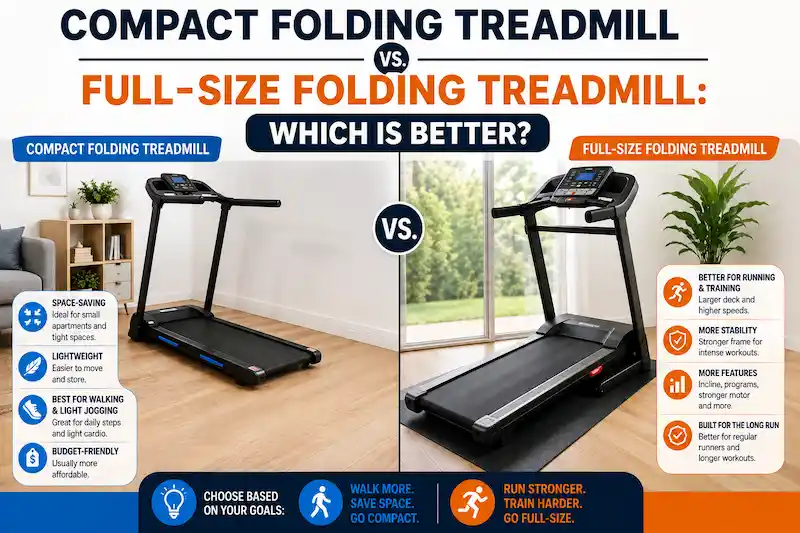
Choosing a folding treadmill for your home often comes down to one important question: Should you buy a compact folding treadmill or a full-size folding treadmill?
Both options can save valuable floor space compared with a traditional non-folding treadmill, but they are designed with different priorities in mind. Compact models focus on easy storage, smaller footprints, and convenience, while full-size folding treadmills generally offer larger running surfaces, stronger motors, and a more stable experience.
The right choice depends on how you plan to use the treadmill, how much space you have available, and whether you primarily walk, jog, or run.
In this guide, I’ll compare compact folding treadmill and full-size treadmill across the features that matter most, including size, running surface, motor power, stability, speed, incline, storage, noise, comfort, and price.
What Is a Compact Folding Treadmill?
A compact folding treadmill is designed primarily to minimize the amount of space it occupies.
These treadmills typically have a shorter or narrower running deck and a smaller overall frame. When folded, some models can be stored against a wall, inside a closet, under certain furniture, or in another relatively small space.
Compact folding treadmills are particularly popular with people who live in apartments, condos, small houses, or homes where the treadmill needs to share space with other activities.
The main advantage is straightforward: you get a compact folding treadmill without giving up as much of your living space.
However, the smaller design can involve compromises. The running belt may be shorter, the motor may be less powerful, and the frame may not feel as substantial as that of a larger treadmill.
For walking and light jogging, these limitations may not matter much. For regular running, they can become more important.
What Is a Full-Size Folding Treadmill?
A full-size folding treadmill combines a larger treadmill frame and running deck with a folding mechanism.
Although it can still be folded for storage, it is generally closer in size and construction to a traditional treadmill.
Full-size folding treadmills usually provide more room to move, larger running belts, stronger motors, higher maximum speeds, and heavier frames.
This makes them a better option for people who want to run regularly but still need the ability to fold the treadmill when it is not being used.
The trade-off is that a full-size treadmill still requires more room, even when folded. It may also be heavier and more difficult to move.
Compact Folding Treadmill vs. Full-Size: Quick Comparison
| Feature | Compact Folding Treadmill | Full-Size Folding Treadmill |
|---|---|---|
| Space requirements | Excellent | Good |
| Storage | Easier | More difficult |
| Running surface | Smaller | Larger |
| Walking | Excellent | Excellent |
| Jogging | Good | Excellent |
| Running | Depends on model | Usually better |
| Stability | Good to moderate | Usually better |
| Motor power | Usually lower | Usually higher |
| Maximum speed | Often lower | Usually higher |
| Incline options | Model dependent | Generally more options |
| Portability | Easier | More difficult |
| Price | Often lower | Usually higher |
| Best for | Walkers and small spaces | Runners and serious workouts |
The specifications vary considerably between individual models, so these are general differences rather than rules that apply to every treadmill.
1. Size and Space Requirements
This is where compact folding treadmills have their biggest advantage.
If you live in a small apartment or have limited space, a compact treadmill can make home workouts much easier to manage. Its smaller frame takes up less floor space, and the folded dimensions can make storage more practical.
A full-size folding treadmill requires more room. Even though the deck folds upward, the base and frame can still occupy a significant amount of floor space.
Before buying either type, measure the area where you intend to use the treadmill. Don’t only measure the treadmill itself. You should also leave enough room around it for safe access and comfortable workouts.
Best choice for limited space: Compact folding treadmill.Look my Budget options.
2. Running Belt Size
The running surface is one of the most important differences between the two categories.
Compact treadmills generally use shorter and narrower belts. This can be perfectly adequate for walking, especially at moderate speeds.
However, running requires more space. As your speed increases, your stride length and natural movement can make a small running deck feel restrictive.
Full-size folding treadmills generally provide a larger running surface. This can make a significant difference for taller users and anyone who intends to run frequently.
If you’re primarily going to walk while watching television or working toward a daily step goal, a compact belt may be sufficient.
If you plan to run several miles several times per week, a larger deck is usually the safer choice.
Best choice for running comfort: Full-size folding treadmill.Look my Mid-Range and Premium options.
If you plan to run regularly, choosing a treadmill with enough space for your natural stride is especially important. For general exercise recommendations, see the American College of Sports Medicine physical activity guidelines.
3. Motor Power
Motor power is another area where full-size treadmills often have an advantage.
Compact folding treadmills are frequently designed around walking and light jogging, so they may use smaller motors. This helps keep the treadmill lighter and more compact.
Full-size models commonly use more powerful motors because they are designed to handle higher speeds and longer workouts.
That doesn’t mean you automatically need the most powerful motor available.
If your primary activity is walking, spending significantly more for a powerful motor may not provide much practical benefit.
For frequent running, however, motor performance becomes much more important.
Best choice for frequent running: Full-size folding treadmill
4. Stability
A treadmill should feel stable while you’re using it.
Compact folding treadmills can provide excellent stability, but their lighter frames and smaller dimensions can sometimes make them feel less substantial than larger machines.
Full-size folding treadmills typically have heavier frames and larger bases. This can provide a more planted feeling, particularly when running at higher speeds.
For walking, the difference may be barely noticeable.
For fast jogging or running, stability becomes much more important because each stride generates greater impact and movement.
Best choice for maximum stability: Full-size folding treadmill
5. Walking Performance
For walking, compact treadmills can be extremely practical.
If your goal is to get more steps, walk while watching television, maintain daily activity, or complete moderate cardio sessions, you may not need a large running deck.
In fact, buying a full-size treadmill when you only plan to walk can mean spending more money and using more space than necessary.
A compact treadmill can provide everything a casual walker needs while being easier to store.
Best choice for walking: Compact folding treadmill
6. Jogging and Running
The situation changes when you move from walking to jogging and running.
At higher speeds, a larger deck becomes more valuable. You need enough room to maintain a natural stride without constantly worrying about stepping too close to the front or sides of the belt.
A full-size folding treadmill is generally the better option for people who plan to make running a major part of their workout routine.
That doesn’t mean every compact folding treadmill is unsuitable for running. Some compact models are designed for relatively high speeds. The key is to examine the actual running surface, maximum speed, motor specifications, and weight capacity rather than judging a treadmill solely by its size.
Best choice for regular running: Full-size folding treadmill
Regular treadmill walking can be a practical way to add more physical activity to your routine. The American Council on Exercise provides additional guidance on the benefits of regular physical activity.
7. Incline Features
Incline training can make treadmill workouts considerably more challenging.
Compact folding treadmills may offer manual or powered incline systems, depending on the model. However, smaller models sometimes provide fewer incline options.
Full-size folding treadmills tend to offer more advanced incline systems, including multiple incline levels and electronically controlled adjustments.
If you enjoy hill workouts, interval training, or increasing workout intensity without dramatically increasing your running speed, incline can be an important feature to prioritize.
Best choice for advanced incline workouts: Full-size folding treadmill
8. Storage and Portability
This is another major advantage for compact models.
A compact folding treadmill is generally easier to move, especially if it includes transport wheels and a relatively lightweight frame.
That makes it more practical for users who need to move the treadmill between rooms or store it after every workout.
Full-size folding treadmills can also be folded and moved, but their greater weight can make the process more difficult.
If you know you’ll need to put the treadmill away after every workout, consider not only its folded dimensions but also its weight.
Best choice for frequent storage: Compact folding treadmill
9. Noise
Noise can be an important consideration in apartments and shared living spaces.
There is no universal rule that compact treadmills are quieter than full-size models. Noise depends on the motor, belt, deck construction, user weight, speed, and floor surface.
However, walking on a compact treadmill at lower speeds can often produce less overall mechanical and impact noise than running on a larger treadmill at high speed.
If you’re planning to use the treadmill in an apartment, pay attention to both motor noise and footfall impact.
A treadmill mat can also help reduce vibration transferred into the floor.
10. Weight Capacity
Weight capacity is an important specification that should never be overlooked.
Compact folding treadmills can have lower maximum user-weight ratings because their frames are designed to remain lightweight.
Full-size treadmills generally offer heavier-duty construction and may support higher user weights.
If you’re close to a treadmill’s maximum weight rating, choosing a heavier-duty model can provide a more comfortable and potentially more durable experience.
Rather than selecting a treadmill based solely on its advertised maximum capacity, look at the overall frame construction and intended use as well.
Best choice for heavier-duty use: Full-size folding treadmill
11. Price
Compact folding treadmills are often less expensive than full-size models.
This is partly because they use smaller frames, smaller decks, and sometimes less powerful motors.
For someone who only needs a treadmill for walking, this can make a compact model an excellent value.
Full-size folding treadmills generally cost more, especially when they include features such as powered incline, larger displays, stronger motors, larger running surfaces, and advanced workout programs.
However, price shouldn’t be considered in isolation.
Buying a cheap compact treadmill that doesn’t meet your needs can ultimately be more expensive than buying the right full-size treadmill the first time.
Compact or Full-Size: Which Should You Buy?
The best option depends primarily on your workout style.
Choose a compact folding treadmill if:
- You have limited floor space.
- You live in an apartment or smaller home.
- Walking is your primary exercise.
- You need to store the treadmill after every workout.
- Portability is important.
- You want to spend less.
- You occasionally jog but don’t plan to run long distances.
Choose a full-size folding treadmill if:
- You regularly jog or run.
- You want a larger running surface.
- You are taller and have a longer stride.
- Stability is a high priority.
- You want stronger motor performance.
- You plan to use incline training.
- You expect longer or more demanding workouts.
- You don’t mind giving up additional storage space.
What About People Who Both Walk and Run?
This is where the decision becomes more difficult.
If you alternate between walking and running, don’t automatically choose the smallest treadmill available simply because it folds.
Instead, focus on the specifications that affect running performance.
Look closely at the belt dimensions, maximum speed, motor, weight capacity, incline system, and overall frame stability.
A slightly larger folding treadmill may be a much better long-term investment if you expect your fitness routine to become more demanding.
On the other hand, if you only run occasionally and spend most of your time walking, a compact treadmill may offer a better balance between performance and convenience.
Don’t Forget the Folded Dimensions
One common mistake is to look only at the treadmill’s dimensions when it is unfolded.
A treadmill can have a relatively small footprint during a workout but still be surprisingly large when folded.
Before buying, measure:
- The available workout area.
- The folded storage area.
- Doorways and hallways the treadmill must pass through.
- Ceiling clearance if the treadmill folds vertically.
- Space around the treadmill for safe use.
Also consider whether you can realistically move the treadmill yourself. A compact model that weighs significantly less may be much more convenient than a full-size machine.
The Bottom Line
So, which is better: a compact folding treadmill or a full-size folding treadmill?
There isn’t one answer for everyone.
A compact folding treadmill is better for people who prioritize space, storage, portability, and value, particularly if walking is their main form of exercise.
A full-size folding treadmill is generally better for runners and more serious home users who want a larger running surface, greater stability, stronger performance, and more workout options.
The biggest mistake is choosing based only on the treadmill’s folded size or price. Think about how you will actually use the machine six months or a year from now.
If you’re buying primarily for walking in a small apartment, a compact folding treadmill can be an excellent choice. If you want to run regularly and have enough room for a larger machine, the additional size of a full-size folding treadmill can be well worth it.
Ultimately, the best folding treadmill is not necessarily the smallest or the most powerful one. It’s the model that gives you enough performance for your workouts while fitting comfortably into your home and your budget.